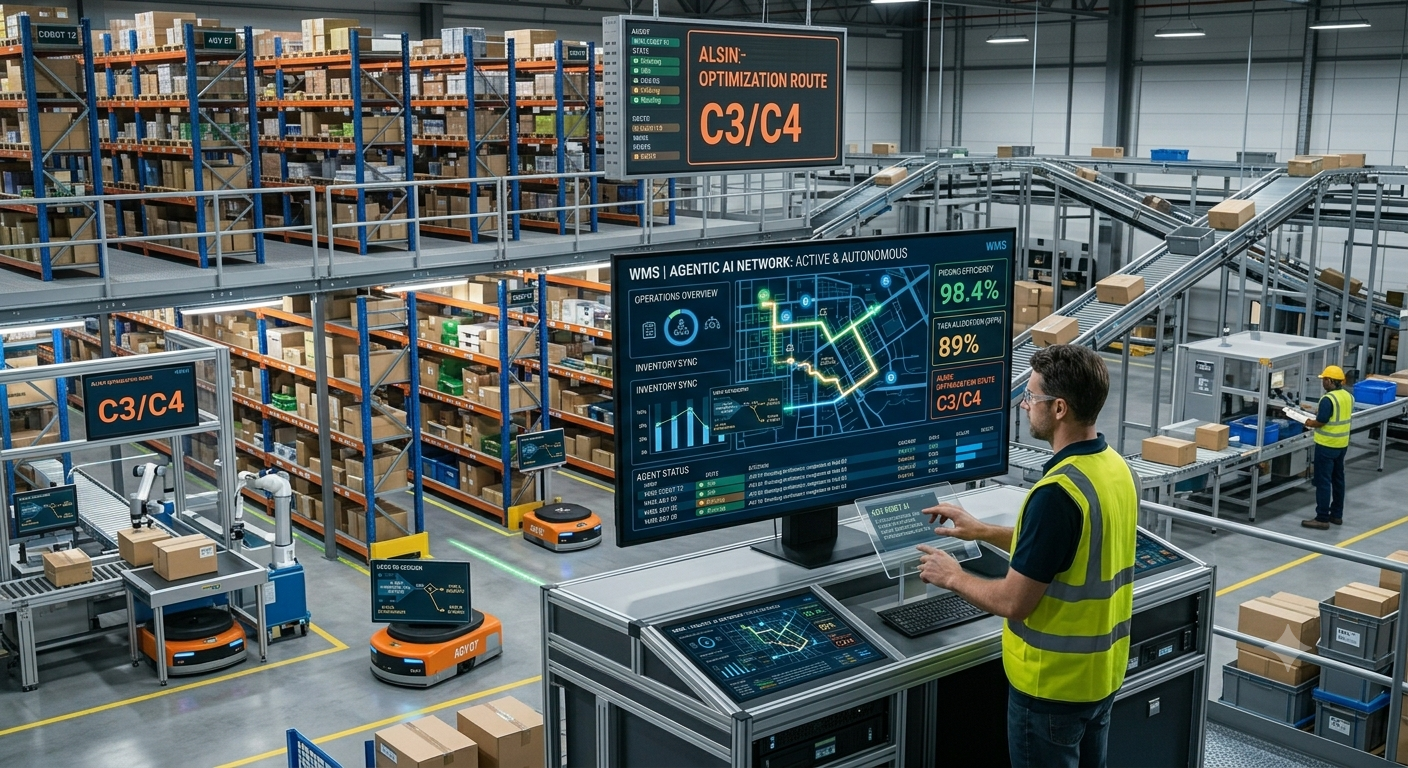
There is a structural shift happening in the warehouse software market this year, and it is easy to miss because it does not arrive as a flashy new feature. Writing for Logistics Viewpoints in late May, Gaven Simon described the 2026 WMS as transitioning from a transactional system of record to a coordination layer across warehouse execution. That single sentence captures a change I have watched unfold project by project, and it deserves more attention than a trend headline usually gets.
From ledger to orchestrator
For most of its history, the WMS has been a very disciplined accountant. It knew what was where, what moved, and what shipped. That was enough when the floor was mostly people with RF guns. It is no longer enough. Simon's argument is that automation has stopped being an add-on and has become a central requirement, with systems expected to integrate robotics, autonomous mobile robots, and material handling equipment while balancing human and machine workflows. The WMS is being asked to orchestrate work across people, automation, and adjacent digital systems rather than simply record what already happened.
This reframing has teeth. A system of record can tolerate being slightly behind reality; a coordination layer cannot. The moment a fleet of AMRs is taking direction from your warehouse software, latency and data accuracy become operational constraints, not reporting niceties. Simon notes the broader convergence too: the WMS increasingly functions as part of an ecosystem that includes transportation, yard, labor, and order management, with vendors positioning their products as integrated platforms rather than standalone applications.
AI as a co-pilot, not an oracle
The second thread running through the 2026 commentary is where AI actually fits. Simon points to AI embedded in WMS platforms for predictive analytics, dynamic slotting, and operational decision-making, with agent-based tools that help diagnose issues and simulate outcomes, and chatbots that let operators get to information faster and cut decision time.
Nina Bäuchler at KNAPP framed the same idea well in March, describing AI as the co-pilot rather than the pilot.
AI will be the co-pilot, supporting operational control, prioritizing recommendations and adjusting processes flexibly.
I like that framing because it sets the right expectation. The valuable applications she lists are unglamorous and real: workload balancing, order prioritization, and predictive resource planning driven by machine learning inside the WMS and WES. She also highlights swarm-style orchestration of AMR fleets, where multi-agent systems coordinate robots in real time to prevent congestion and learn from bottlenecks, and computer-vision quality control that captures barcodes and identifies items during movement without a manual scan. These are not science projects. They are the connective tissue that lets a coordination layer actually coordinate.
Why the architecture conversation matters now
Here is the part that should concern anyone responsible for a live operation. A coordination layer is only as good as the configuration and data underneath it. Both Simon and Bäuchler, from different angles, land on the same dependency: forecasting and digital twins are only useful when fed clean internal and external data, and orchestration only works when the WMS reflects the floor accurately and quickly. Notably, ARC Advisory Group is even restructuring how it evaluates WMS vendors this year, shifting toward functional capability, technical architecture, automation integration, AI features, and measurable performance impact rather than older segmentation. The analysts are changing their rubric because the product category itself has changed.
What does this mean if you run a warehouse today? First, stop treating your WMS configuration as a one-time implementation artifact. If the system is going to coordinate robots and people in real time, its configuration is a living asset that needs ownership. Second, be honest about your data foundation before you buy the next AI module, because a co-pilot pointed at messy data will confidently steer you into a wall. Third, evaluate new capability the way the analysts now do: not by feature count, but by whether it genuinely orchestrates work across people, automation, and the systems around it.
The reassuring news is that none of this requires ripping anything out. The shift from system of record to coordination layer is evolutionary, and the warehouses that handle it best are the ones that get their data and configuration discipline right first, then layer automation and AI on a foundation that can actually be trusted. The unglamorous work is, as usual, the work that pays.
Sources: Logistics Viewpoints: https://logisticsviewpoints.com/2026/05/12/the-digital-backbone-of-the-warehouse-trends-shaping-the-2026-wms-market/ ; KNAPP: https://www.knapp.com/en/insights/blog/ai-trends-logistics-2026/