Steve Banker's latest piece in Forbes carries a headline that sounds like every other AI story this year: Blue Yonder's supply chain agents are getting really smart. I clicked expecting the usual autonomy sizzle. What I found instead was one of the more sober descriptions of enterprise agents I have read in months, and it happens to be about the platform I spend most of my working life inside. So I want to unpack it from the floor, not from the keynote.
2.5 billion dollars, and the LLM is a supporting actor
The number that anchors Banker's article is the investment: Blue Yonder has put roughly 2.5 billion dollars over four years into rebuilding its stack around an agentic framework, breaking its applications into specialized components with defined inputs and outputs that can be orchestrated like modular parts. That is a serious re-platforming, not a feature release. But the detail that actually matters is quieter. Blue Yonder is explicit that large language models are just one tool among many, sitting alongside traditional transaction processing for warehouse operations, optimization engines for transport and supply planning, and classic machine learning for demand planning.
If you have read anything I have written before, you know why that lands for me. The failure mode I keep warning clients about is pointing a general-purpose model at a warehouse and hoping fluency substitutes for correctness. Blue Yonder is, in effect, saying the same thing with a 2.5 billion dollar budget behind it: the model reasons, but the optimizer optimizes and the transaction engine executes.
Supply chain is not a generic reasoning problem
The line I keep coming back to is from CEO Duncan Angove, quoted framing the whole design philosophy: supply chain is not a generic reasoning problem. It involves hard constraints, real-time execution, and decisions that are interconnected across warehousing, transport, and planning. That single sentence explains why the industry's rush to wrap everything in a chat box has felt off to practitioners.
A warehouse does not need a model that can reason about anything. It needs a system that respects the constraints that are actually binding at 2pm on a peak Friday, and acts inside them.
Constraints are the whole job on the floor. Dock capacity, labor availability, replenishment debt, carrier cutoffs: these are not soft preferences a language model can talk its way around. An agent that treats them as suggestions strands a truck. Angove's framing is a recognition that the reasoning layer has to be bounded by hard operational limits, which is exactly the discipline enterprise agents have mostly lacked.
Five agent types, and the one I care about
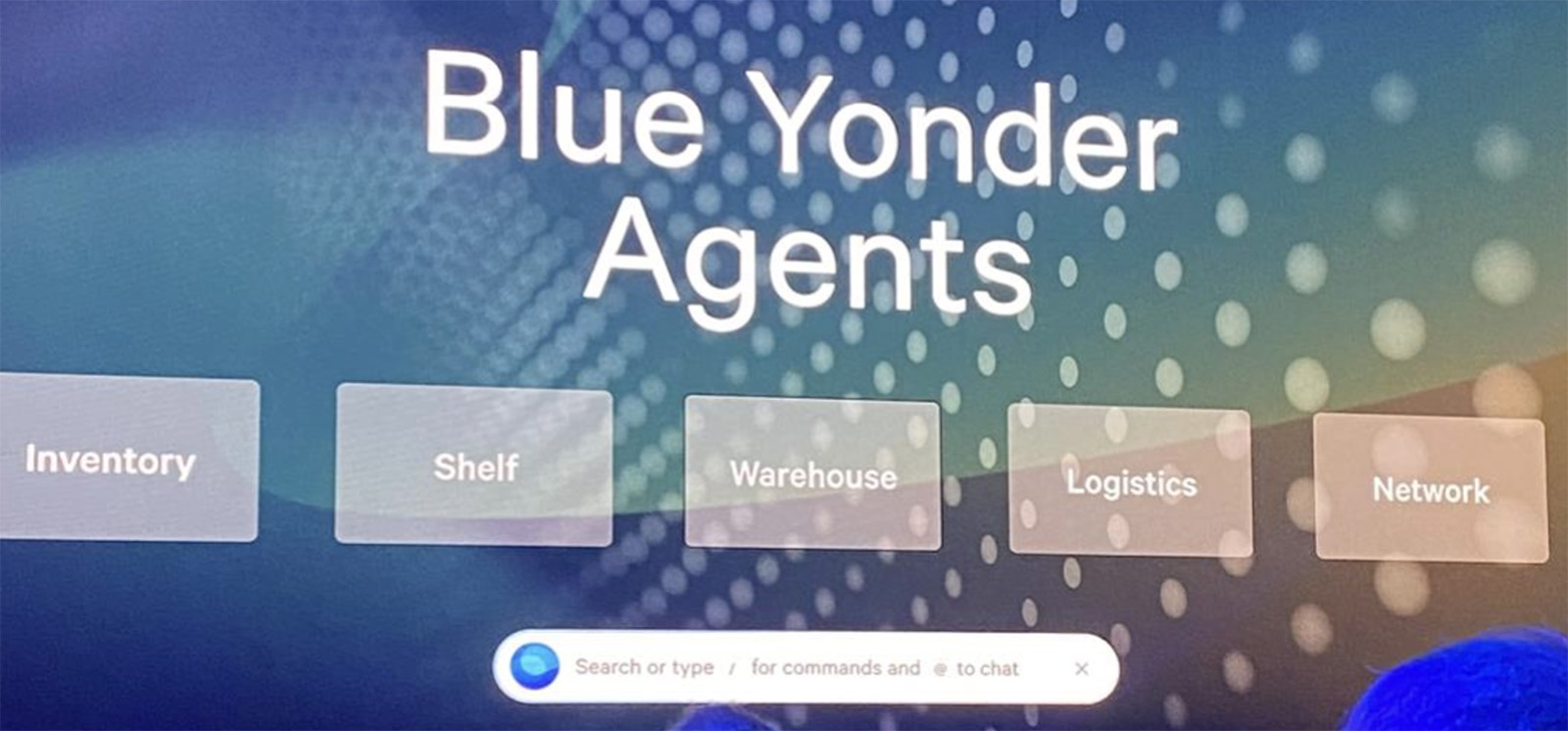
Banker lays out five core agent families in the new architecture: inventory ops, logistics ops, warehouse ops, space ops, and network ops. Each is built as an agent that contains subagents with specialized skills aimed at a specific outcome. A couple of examples are worth pulling out. The inventory ops agent now evaluates demand fulfillment against production and supply constraints rather than in isolation. The network ops agent pulls in real-time risk data to identify constrained nodes, and can even derive bill-of-material data to work out which product families a disruption actually touches.
But the one I care about is warehouse ops, because that is my patch. Banker highlights enhanced slotting and automated prioritization during disruptions. Read that carefully. Slotting and disruption re-prioritization are precisely the tasks where a good recommendation saves a shift and a bad one quietly bleeds pick rate for weeks. If Blue Yonder can make those genuinely adaptive: reslotting as demand shifts, resequencing work when a disruption hits, without turning the floor into a black box, that is real value. The caveat I always add applies here too: a slotting model is only as trustworthy as the configuration and data it reasons over.
The plumbing is the story
Two partnerships in the article tell you where the hard engineering actually is. Blue Yonder is working with Snowflake for unified data modeling and knowledge graphs, and with NVIDIA on what they call a Model Training Factory to bring down the cost of building and training these agents. Neither of those is glamorous. Both are the unglamorous foundation I keep insisting matters more than the demo: a coherent data model the agents can trust, and a repeatable way to produce specialized models instead of hand-crafting each one.
This is the part operators should internalize. The agent you see on the slide is the last mile. The knowledge graph underneath it, the thing that lets a network ops agent know that a delayed component maps to these three finished-goods families and those two customers, is the actual product. Grounding is not a nice-to-have bolted onto the model; in this architecture it is the substrate the model stands on.
The number that will get quoted
Every article like this needs a customer proof point, and Banker's is Sainsbury's, the UK's second-largest grocer. The figures are striking: 150,000 fewer disposals during the 2025 peak season and 800,000 fewer markdowns through improved accuracy, alongside better resilience and forecasting. I treat single-customer numbers the way I treat any vendor case study: directionally interesting, not a promise I would repeat to a client as their expected outcome. But the shape is credible. Fresh grocery is a constraint-dense, perishable, time-critical operation, which is exactly the environment where respecting hard constraints in real time should pay off. If agentic execution is going to prove itself anywhere first, a grocer's supply chain is a reasonable place to look.
What I would take to a client
Strip away the funding number and the case study, and Banker's article is really documenting an architectural argument I happen to agree with. Autonomy is not the interesting variable. The interesting variables are whether the agent is bounded by real constraints, whether it is grounded in a data model that reflects your actual operation, and whether the reasoning layer stays in its lane while the optimizer and the transaction engine do the deterministic work. Blue Yonder has spent 2.5 billion dollars arriving at a design that says: the LLM is one tool, the constraints are non-negotiable, and the data foundation is the real investment.
For anyone running Blue Yonder WMS today, none of this is something you buy tomorrow. But it is a clear signal of where the platform is heading, and it rewards the same preparation I always argue for. Get your configuration and data discipline right now, because the agents that are coming will only ever be as smart as the operation you let them reason about. Getting really smart, it turns out, still starts with getting the basics clean.
Sources: Forbes: Steve Banker, "Blue Yonder's Supply Chain Agents Are Getting Really Smart": https://www.forbes.com/sites/stevebanker/2026/06/05/blue-yonders-supply-chain-agents-are-getting-really-smart/