
On 29 July, OpenAI announced its intention to provide free access to its AI tools to 100,000 scientists. The headline sounds like a large academic subscription programme. I think it is more interesting than that.
If the initiative reaches the scale OpenAI has announced, we'll have a real-world experiment on what happens when advanced reasoning, coding agents, in-depth research, specialised skills, and scientific data connections cease to be scarce capabilities available only to a few well-funded teams.
This mix can provide immediate results at the level of code, analysis, and hypothesis. The real operational question here is whether the systems used to verify, reproduce, and maintain that work can scale up at the same pace (honestly, I doubt it for now).
The headline is access, the deeper change is infrastructure
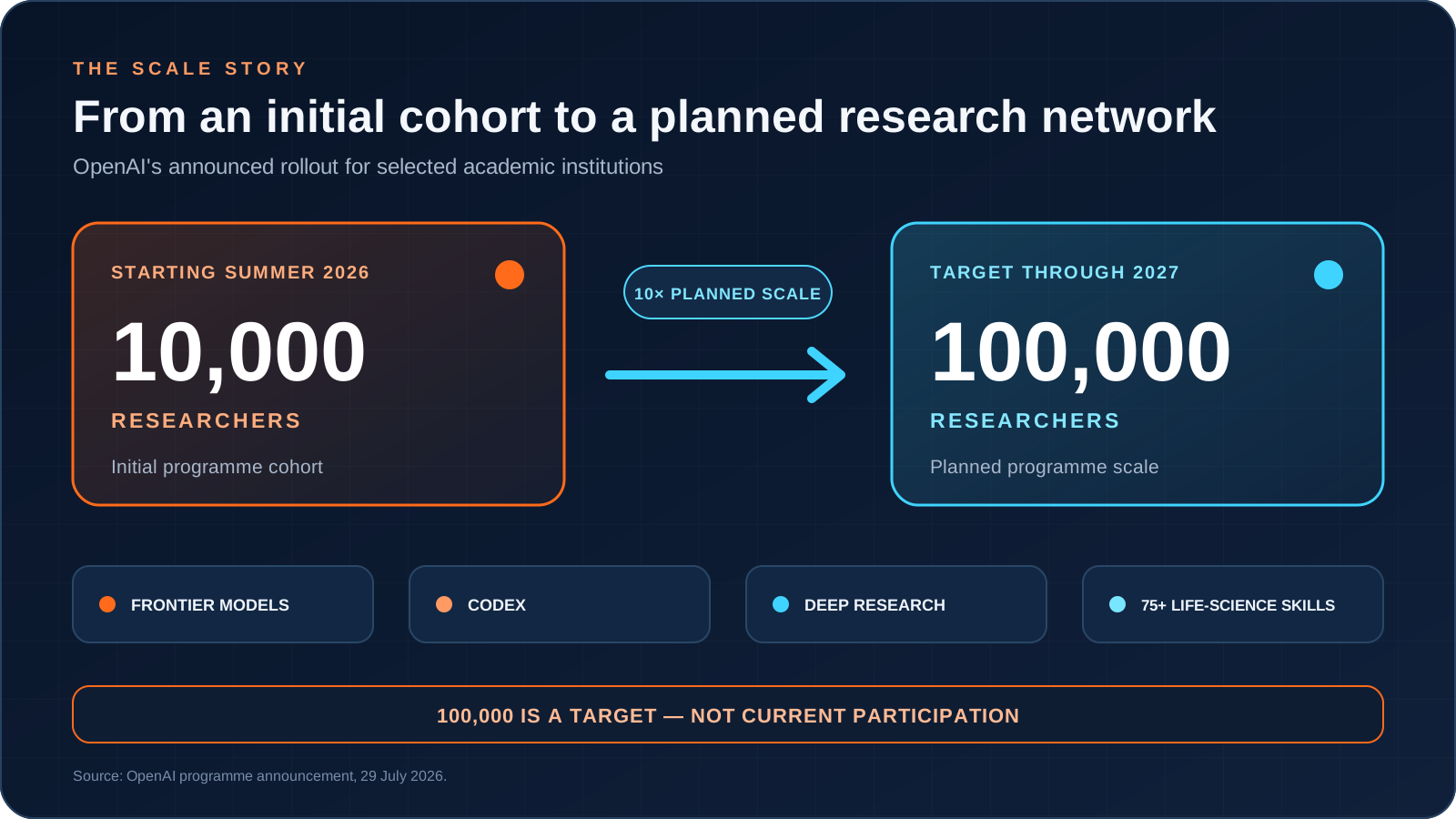
ChatGPT for Academic Researchers will begin with 10,000 researchers during summer 2026. OpenAI says it plans to expand the programme to 100,000 participants at selected academic institutions through 2027. Approved researchers will also be able to invite up to four collaborators from their institution.
This distinction is important; it's not yet a universal right for 100,000 people, nor is it an independently evaluated scientific outcome. It's the launch of a programme with a common objective and a plan for tenfold expansion, which I fear won't be the last we see from other companies.
Participants are expected to have access to ChatGPT, ChatGPT Work, and Codex, including the new models in the GPT-5.6 family (Sol, Terra, and Luna). OpenAI also describes more than 75 life-science skills (a number that will surely increase), alongside connectors to literature, genomic databases, computational notebooks, satellite imagery, and reference managers.
Without a doubt, this combination transforms how they use the model: it will no longer be a simple space to wait for answers to their questions, but a workspace capable of searching, programming, connecting to other tools, processing data, and carrying out work in various stages of research and development.
A scientific instrument made of software
Today, every laboratory, no matter how specialised, relies on instruments that expand its observation and measurement capabilities. Increasingly, these environments are expanding their use of AI across all workflows, thereby improving tasks such as review, hypothesis generation, writing analytical code and case studies, error detection, iterations, preparing visualisations, communicating results, and more.
OpenAI reports that approximately 1.3 million people already use ChatGPT weekly for advanced science and mathematics, generating roughly 8.4 million messages. It is not surprising to see how these new models are increasingly capable of solving even mathematical problems that have been unsolved for years (Nobel Prize-winning physicist and team use Claude AI to solve decades-old math puzzle, Ten Advances in Mathematics and Theoretical Computer Science).
These figures come from the analysis of OpenAI usage and should be interpreted as indicators of activity, not as proof of scientific impact.
Where is the work headed?
One day before the programme announcement, OpenAI published an exploratory field report covering eight agent-assisted scientific-computing projects, primarily in life sciences. Five used Codex alone and three used a combination of Codex and Claude Code.
The projects ranged from packaging and maintenance to performance optimisation, language migrations and GPU-native redesigns. Contributors reported substantial improvements in several cases, but the report is careful about its limits: the project teams supplied the case studies, and the authors did not independently reproduce every benchmark or validate every reported result.
The most valuable finding is not a speed-up figure. It is where the human effort moved.
Agents were most useful when success could be checked against something outside the agent itself: byte-identical output, agreement with an existing implementation, known answers from simulated data, statistical behaviour or acceptance criteria defined in advance. In all but one project, people remained the principal judges of whether the work was actually complete.
When implementation becomes cheaper, verification does not disappear. It becomes the main design problem.
Until recently, agents typically generated an initial implementation very quickly, while edge cases, numerical discrepancies, or data errors required more time. Today, this has accelerated development to such an extent that the final phase, revision and correction, is even more costly because the agent's confidence is not evidence of correctness.
More ambitious requests do not prove better outcomes
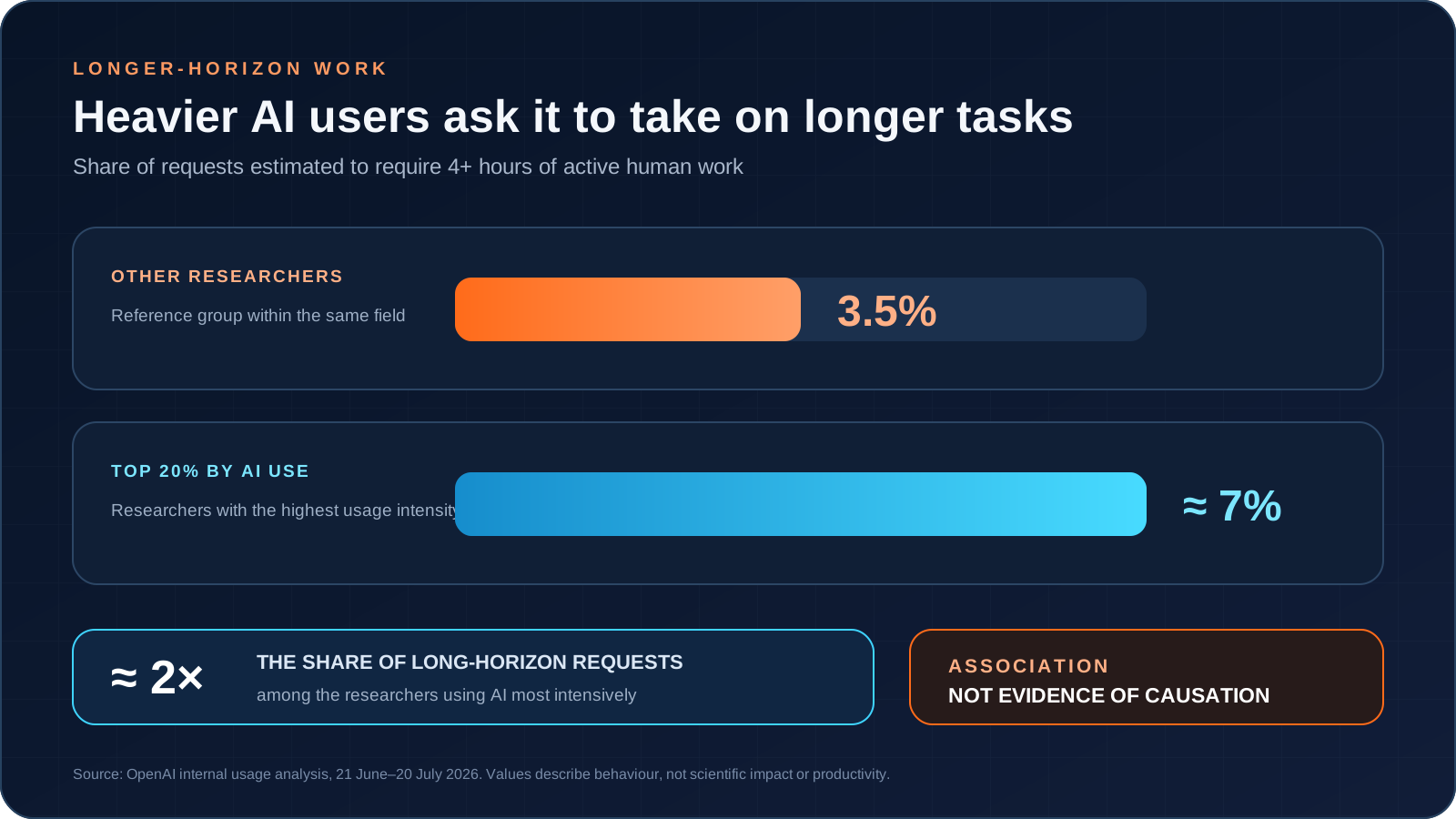
This new programme announced by OpenAI includes another interesting finding. Researchers in the top 20% by AI usage within their field are nearly twice as likely as their peers to submit requests for tasks estimated to require four or more hours of active human work: almost 7% of their requests compared to 3.5% for other researchers.
Looking at these numbers, we can see that in terms of productivity, the relationship could be reversed: researchers working on more ambitious problems might simply use AI more to get more support on individual questions and to help them with larger workflows, but this in turn generates more human time for them to delve deeper and verify those results (for now).
- Why is this important?
Longer multi-step workflows can also create more opportunities for error and, consequently, a flawed analysis process that contaminates subsequent results. The more steps an agent completes autonomously, the more important it becomes to preserve the source data, intermediate results, model versions, and acceptance tools and tests at the exact point where a human approved the result.
This is where scientific AI starts to resemble operational AI.
What would this look like inside a WMS operation?
Imagine a supply-chain analyst investigating recurring short picks. An agent could query historical orders, generate SQL, group exceptions by item and location, build a simulation and propose a new replenishment threshold. Undoubtedly, with the use of AI, this task, which previously required several people and hours, could significantly accelerate the first analytical pass.
That speed is valuable, but I would not move the proposed threshold into production because the charts look convincing. I would want to know:
- What inventory snapshots and transaction types were included?
- Were cancelled orders, stock status changes, and late confirmations handled correctly?
- Was the customer consulted and were available resources considered?
- Does the proposal outperform the current rule over a representative evaluation period?
- What happens to movement, congestion, and reserve stock when demand changes?
- Can the result be reproduced with the same input data?
- Who owns the model, the test suite, and the decision once the original analyst leaves the role?
This is the warehouse equivalent of scientific validation. The agent can implement the idea, but the operation needs an external reference, measurable success criteria and a controlled route from analysis to execution.
The scarce capability may no longer be writing the first version. It may be constructing the evidence required to trust it.
Scaling access means scaling responsibility and control
There is another elephant in the room regarding risks: as software becomes inexpensive, teams can create increasingly overlapping tools. Scientific communities could end up with multiple versions of the same AI-written library, each initially impressive, but none with clear responsibility or scalable maintenance for collaborative work.
The report undoubtedly advocates for responsible collaboration and discusses a shared level of maintenance with a common vision of long-term ownership. This principle applies directly to enterprise technology: every useful component generated by an agent must have an owner, version control, testing, documentation, and an end-of-life plan. Otherwise, productivity improvements will be hampered by a reliance on tools that will no longer be supported.
OpenAI states that, by default, researchers' data will not be used to train its models and that the workspaces will include business-grade privacy and security protections (we'll see, life has shown us that nobody gives anything away for free).
The real experiment comes next
Undoubtedly, the simplest way to quantify the effectiveness of this initiative would be to measure the use of activated accounts, messages, and generated code. However, this won't tell us whether the programme improved the science behind its use. For that, we would need to look for outputs that survive human review: reproducible analyses, software changes accepted by developers and researchers, experiments with proven success criteria, visible negative results, and tools that are maintained afterward, etc.
As we can see, this is a very ambitious plan, and I have no doubt that reaching 100,000 expert researchers is more than significant. This goes beyond whether academics want or need to base their work on the use of AI; it goes beyond whether institutions (both public and private) are keeping pace to absorb such a drastic increase in the rate of idea generation and new research, something I currently doubt.
Finally, I think this same principle can be applied both in a research laboratory and in a warehouse: never increase your capacity to produce work with an agent faster than your capacity to verify what changes that work produces in its environment.
---
Sources: OpenAI, Accelerating scientific discovery with ChatGPT for Academic Researchers · OpenAI, Scientific computing in the age of agentic AI · Jeremy Li et al., Scientific computing in the age of agentic AI: an exploratory field report · Official OpenAI documentation, ChatGPT use cases for research